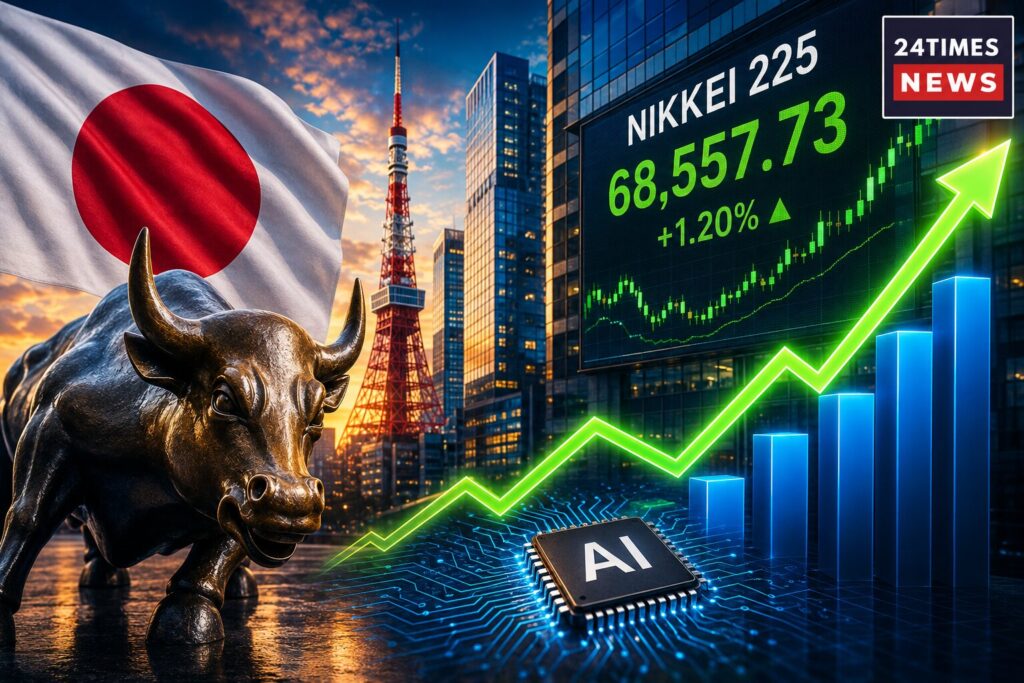
Japanese stocks finished the week with a bang on Friday, July 10, 2026. The Nikkei 225 bounced back sharply, ending a mid-week slump and closing up 1.2% at 68,557.73. Investors piled into semiconductor and artificial intelligence stocks, while a weaker yen pushed export-related stocks higher. Global markets also felt upbeat, helping Tokyo’s rebound feel solid.
While this rally brought excitement to the market floor, Japan’s economy showed a different side. Fresh data revealed wholesale inflation is picking up speed, which might cause the Bank of Japan to tighten its monetary policy soon.
Table of Contents
Tech and Export Stocks Propel Gains

The Tokyo Stock Exchange opened strong, a direct response to a sturdy tech rally in the US. As trading heated up, large-cap tech stocks took center stage. Investors felt a jolt from the surge in U.S. chipmaker Nvidia, which rippled across Japanese semiconductor-related stocks like Tokyo Electron, Advantest, and Screen Holdings. There was extra momentum from SK Hynix’s blockbuster $26.5 billion IPO in the US, raising the mood for chip suppliers across East Asia.
Currency shifts added fuel to the rally. The yen slipped to 159.25 per U.S. dollar, its weakest level in months. That gave exporters like carmakers and precision instrument companies a clear earnings advantage.
On top of that, oil prices eased. Brent crude slipped to $76 a barrel, a welcome break for Japanese firms reliant on imports. Stable energy costs can help profit margins and keep consumers spending.
Nikkei’s Strong Numbers and Sector Winners
Friday alone, the Nikkei 225 tacked on more than 800 points. Over two days, the index soared nearly 1,740 points – its best run since late June. But for the whole week, the gains weren’t quite enough to recover earlier losses.
Year-to-date, the Nikkei’s up a staggering 36%. Even after some bumps, it’s just 5% below the all-time high set in late June.
Not every part of the market joined in equally. The broader TOPIX nudged up just 0.39%, showing that the strongest action was in bigger, export-oriented tech names.
Here are Friday’s key closing figures:
- Nikkei 225: 68,557.73 (+1.20%)
- TOPIX: 4,036.08 (+0.39%)
- TOPIX Core 30: 2,061.69 (+0.52%)
- TSE Growth Market 250: 718.88 (+1.08%)
Among the session’s biggest winners:
- SUMCO Corp. shot up 15.4% after strong demand for its silicon wafers.
- SoftBank Group took off 10.65%, as investors saw more upside in its AI and semiconductor bets.
- Mitsubishi Motors rose 9.44%, and other exporters saw a boost from the weaker yen.
- Socionext and Tokyo Electron gained as demand for advanced tech returned fast.
Some stocks fell back, though. Chugai Pharmaceutical and Takeda lost ground as money shifted out of defensive stocks and into riskier tech. Tokyo Electric Power pulled back, too, after news of rising wholesale prices added worries about higher imported fuel bills.

Inflation Jumps, Bank of Japan Faces Pressure
The market party came with a warning. Early Friday, Bank of Japan data showed the Corporate Goods Price Index an inflation measure for businesses jumped to 7.1% year-on-year in June. That’s the fastest pace in over three years and above what analysts expected.
Why is this a problem? Higher producer prices hurt profits if businesses can’t pass those costs along to consumers. Most of the price jump came from expensive imports and global shipping snarls, made worse by the softer yen.
With inflation rising, many investors think the Bank of Japan could raise interest rates when it meets at the end of July. That would drive up government bond yields and bring some uncertainty to stocks, especially in financials and real estate.

Strong Trading and Foreign Investor Move
Trading was brisk on the Tokyo Prime Market. Investors bought and sold around 2.57 billion shares, worth nearly ¥4.82 trillion. Foreign investors jumped back into Japanese stocks, buying about ¥185 billion in net purchases and reversing recent outflows.
Regional Markets Also Feel the Surge
Japan’s rally was part of a bigger move across Asia. South Korea’s Kospi outperformed, climbing 2.54% as Samsung and SK Hynix drew buying interest after the IPO news. Hong Kong’s Hang Seng ticked up 0.6%. The only major market that missed out was China’s Shanghai Composite, which slid 1% on worries about real estate.
Nikkei Charts Show Key Support Holding Up
On the charts, the Nikkei 225 bounced neatly off the 67,500 level, which lines up with its 25-day moving average. That’s a healthy sign for bulls heading into the rest of July. The big test coming up is 70,000 points. If the index can break through and hold above this mark, it could make another run at June’s record high of 72,366.
But one thing’s clear: with inflation running hot and a Bank of Japan meeting ahead, traders can expect more twists and turns. All eyes will stay on monetary policy, the yen, and global tech trends as Japan’s stock market navigates a tricky but exciting summer.