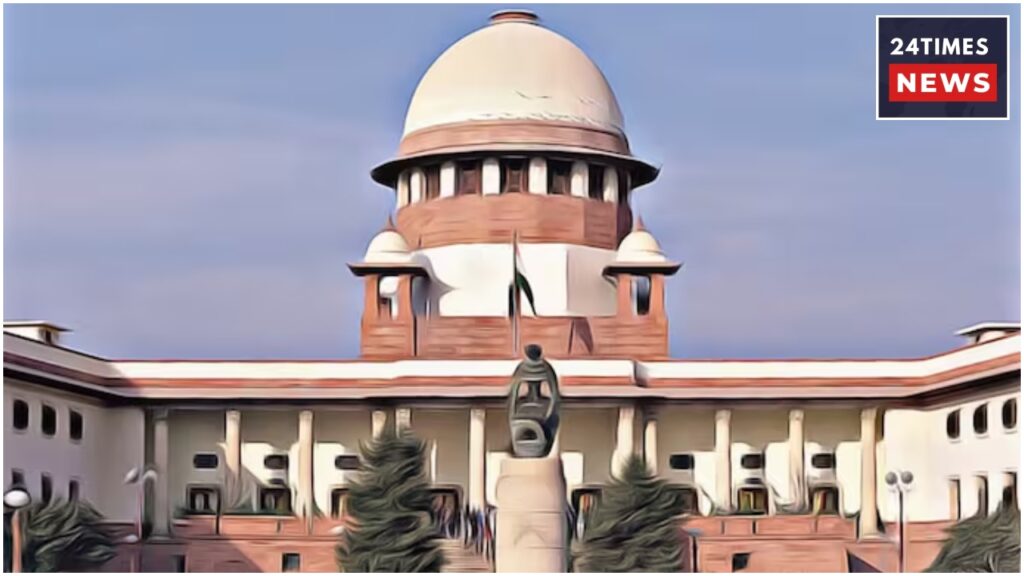
New Delhi: The Election Commission of India has become a subject of discussion. A split verdict has emerged from the Supreme Court regarding the petition seeking the inclusion of the Chief Justice of India (CJI) in the appointment process for Election Commissioners. Justices Dipankar Datta and Satish Chandra Sharma of the Supreme Court bench have requested the Chief Justice to explore the possibility of constituting a permanent five-judge bench to adjudicate on constitutional issues.
During the hearing, Justice Datta stated that he rejected the plea to refer the matter to a five-judge bench. It is worth noting that during the previous hearing, the Central Government had requested that the matter be referred to a five-judge Constitution Bench.
What did Justice Datta say?
During the hearing of the petition in the Supreme Court, Justice Datta stated that he wished to specifically address the argument raised regarding the collegium system for selecting judges. A misconception is often spread that judges alone appoint other judges; however, the process involves extensive deliberation. Justice Datta noted that consultations are held with both the Central and State governments.
Intelligence reports are also taken into account. He remarked that it is entirely incorrect to question the entire system simply because of disputes surrounding one or two appointments. He reiterated that the Central and State governments are consulted and intelligence reports are obtained. He acknowledged the argument that an impartial selection process for Election Commissioners is crucial for maintaining the Election Commission’s neutrality.
He noted the concern that the presence of the Prime Minister and a representative nominated by him on the selection committee could tilt the process in the government’s favour, potentially rendering the role of the Leader of the Opposition in the three-member committee merely tokenistic. He stated that he found merit in this argument.
What did Justice Satish Chandra Sharma say?
Justice Sharma began reading out his order regarding the filed petition. He stated that, with all due respect to Justice Datta, he did not agree with his decision. Justice Sharma further stated that the previous verdict was intended to fill a vacuum.
There was no clear mechanism for the selection process at that time; consequently, the Court had proposed a committee comprising the Prime Minister, the Leader of the Opposition, and the Chief Justice. The situation has changed now, as Parliament has enacted legislation. It is my decision that the matter be placed before the Chief Justice so that a five-judge bench may be constituted.
The matter should be referred to a three-judge bench.
According to Justice Datta, even if our conclusions differ, I believe this matter should now be referred to a three-judge bench. It would be best to place the matter before the Chief Justice so that a five-judge bench can be constituted. He further noted the petitioners’ concern that matters referred to a Constitution Bench often remain unheard for years; we hope for an early hearing in this case.