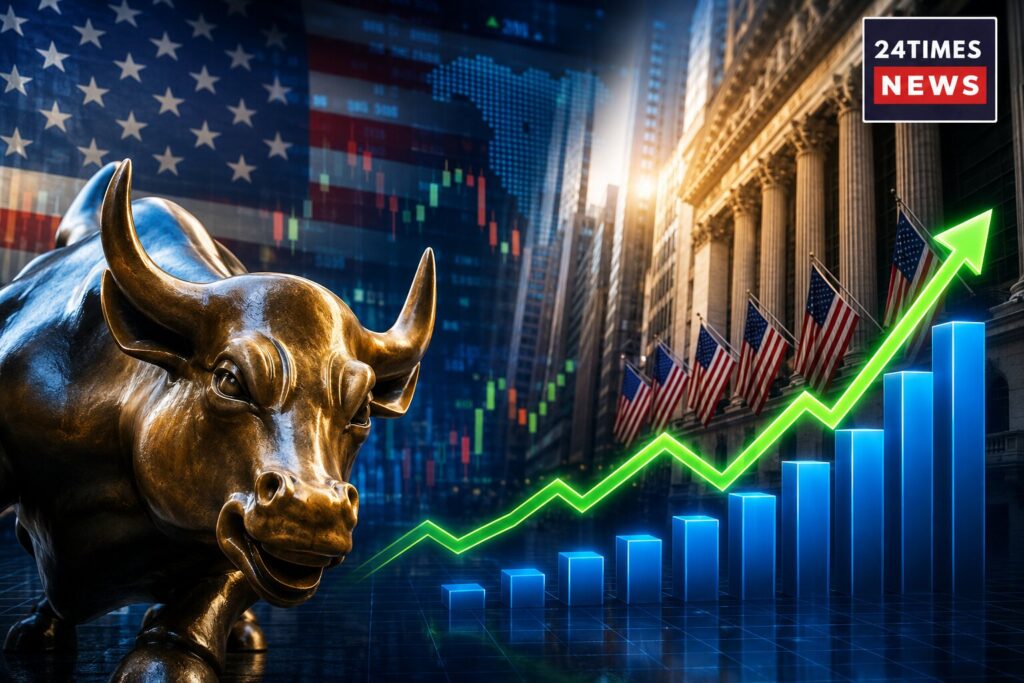
Stocks on Wall Street gave investors a mixed story on Tuesday. While technology giants made headlines by pushing the Nasdaq Composite to a new record, worries over global politics and stubborn inflation kept other markets sluggish. The S&P 500 barely moved, and the Dow fell further, weighed down by trouble in energy, financial, and consumer sectors.
Table of Contents
By the end of the trading day, the numbers told the story:
- The Nasdaq Composite climbed 122 points, closing at a record 27,244. Only the biggest tech firms kept the rally alive.
- The S&P 500 ended the day almost unchanged, just losing a tiny fraction, finishing at 7,764.
- The Dow Jones Industrial Average dropped 185 points, landing at 51,864.
Choppy Under the Surface
While the S&P looked calm on the surface, traders were dealing with a rush of news and tensions. They watched speeches from world leaders at the United Nations, kept an eye on wild commodity prices, and looked ahead to a coming trade summit. Many also tried to guess what the Federal Reserve would do next, especially with inflation still stubborn and oil flirting with the $100-a-barrel mark.
Tech Stocks Lead the Way
Technology stocks were the clear winners. Big chipmakers jumped ahead after companies announced new spending on faster, more powerful data centers. SanDisk’s stock soared over 7%, and Micron Technology went up nearly 4%. The main technology ETF (XLK) rose 0.7%, which was more than enough to help the Nasdaq hit a new record.
But not all tech stock stories were upbeat. Software and app stocks took a beating, especially after Meta Platforms showed off its new AI assistant, called “Muse.” Investors worried that advanced AI would disrupt other business models apps for ride-hailing, online travel, and brokerages saw their stock prices drop. For example, Uber and Lyft each fell about 1%, Expedia tanked by 4%, and Charles Schwab took a hit of 5.5%.
Many Wall Street analysts now warn that as AI tools get smarter, they can book rides, manage accounts, and make travel plans directly, cutting out companies that usually act as middlemen.
Tensions Abroad, Volatility at Home
On top of everything, the world felt tense. Oil prices bounced as traders reacted to threats in the Middle East, especially around the Strait of Hormuz, a crucial shipping lane for global oil. Brent crude settled just under $100 per barrel, and U.S. West Texas Intermediate dropped to $94.59.
Much of the uncertainty came after a speech by President Donald Trump at the UN General Assembly. He issued tough warnings about Iran and made it clear the U.S. would act forcefully if talks didn’t lead to a long-term solution.
All eyes are now on Washington, where diplomats prepare for a summit between President Trump and President Xi Jinping of China. Investors want two big things out of this meeting: more time before the U.S. and China impose new tariffs, and some hints about how governments will handle fast-growing artificial intelligence technology to avoid future trade fights.
Yields Hold Steady as Fed Watches Inflation
In the bond market, things were mostly quiet. The yield on the U.S. 10-year Treasury slipped just a little, closing at 4.94%. That’s still near highs not seen in a while, as investors keep betting that the Federal Reserve isn’t ready to cut rates yet.
Boston Fed President Susan Collins backed the Fed’s recent rate hike, saying energy prices and high spending on services keep inflation strong. New York Fed head John Williams added that, for now, banks can still get the money they need, and the financial system isn’t in trouble.
Still, big banks like JPMorgan, Wells Fargo, and Bank of America all saw their stocks slide, losing up to 1.4% on worries about higher borrowing costs and slower loan growth.
Winners and Losers: Not Everyone Joins the Party
Looking closer at the data, even as the Nasdaq reached a new high, more stocks fell than rose on both the New York Stock Exchange and the Nasdaq. Only a handful of mega-cap tech firms kept the party going. In fact, on the Nasdaq, there were more than twice as many stocks making new lows as making new highs.
The so-called “fear index” (VIX) dropped over 4%, signaling that options traders felt a bit less nervous, mostly because oil prices came down during the day.
A quick look at the day’s sector winners and losers:
- Consumer Staples: Up 1%, showing investors still like steady, reliable companies.
- Technology: Up 0.7% no surprise, given the chip rally.
- Health Care and Utilities: Just a bit better.
- Financials, Energy, Industrials: All lost ground, with consumer discretionary stocks (like retailers and car makers) falling hardest, down over 1%.
What’s Next? Caution Rules the Day
Market strategists on Wall Street now urge investors to stay cautious. While big chipmakers push the market higher, the gains are narrow, and most other companies aren’t keeping up. With Treasury yields stuck above 4.9% and energy prices up and down, profit margins are coming under pressure.
Here’s what most experts are watching for as the quarter ends:
- Results from the U.S.-China summit. Good news here could boost stocks outside the tech sector.
- The next move in oil prices. If crude breaks above $100 again, people might spend less on shopping and travel, which would hurt company earnings.
- Earnings season ahead. Investors want proof that spending on artificial intelligence is actually driving corporate profits. Without solid numbers, the market’s high valuations might look shaky.
For now, Wall Street is walking a tightrope. The tech sector, especially semiconductor makers, keeps breaking records. But with so much up in the air from politics to oil to interest rates every other market segment feels much more cautious.
It’s a waiting game. Investors are betting that high-flying tech shares can keep the party alive a bit longer, but they’re also watching for signs of trouble and hoping global tensions don’t tip the market the wrong way.