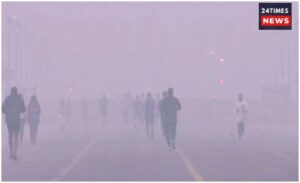
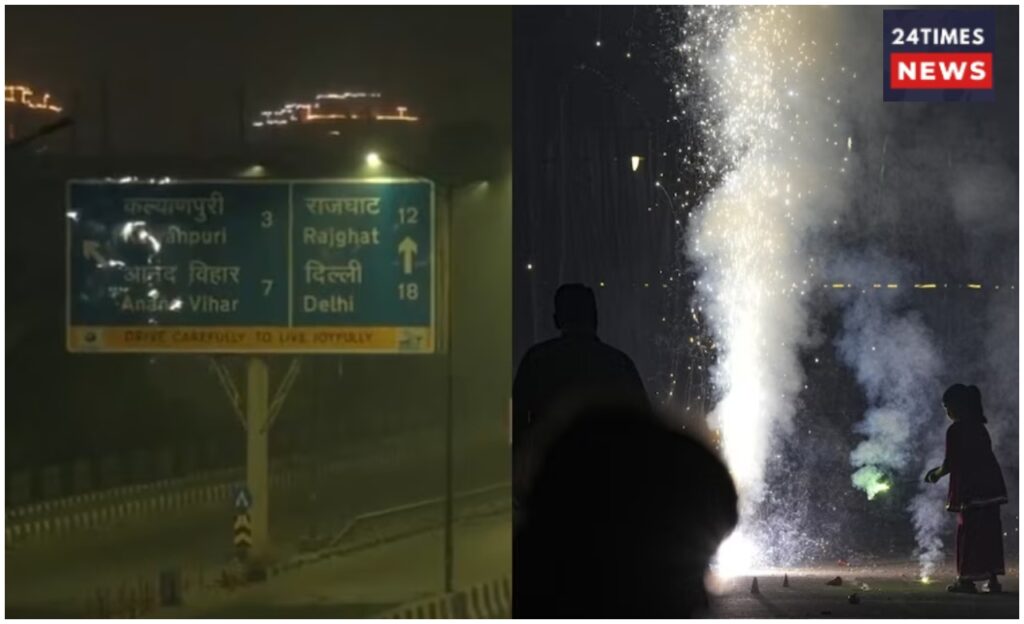
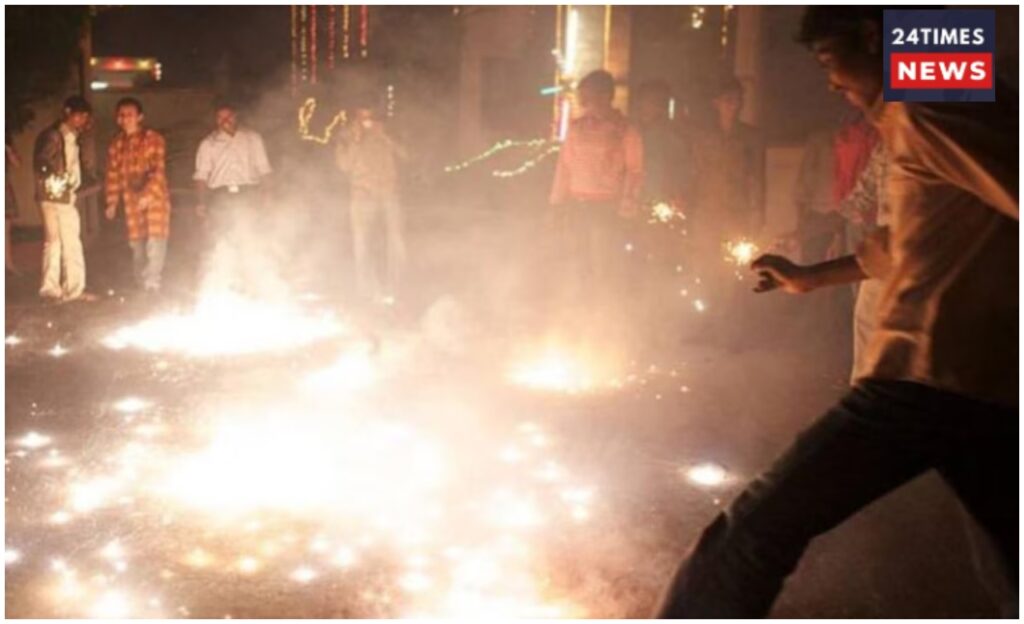
New Delhi: The impact of Diwali fireworks is being felt across Delhi and the NCR region. By Monday morning, the air in Delhi had turned toxic. The capital is now shrouded in a thick blanket of smoke, with conditions expected to worsen. The bursting of firecrackers during Diwali celebrations has led to a sharp rise in pollution levels, pushing the Air Quality Index (AQI) into the ‘severe’ category in several areas.
Visibility has dropped significantly due to the pervasive smoke. The smog is so intense that people have described the experience as akin to smoking cigarettes. Many have begun wearing masks before stepping out of their homes. There is little sign of improvement in the near term; the post-Diwali smog, which had been anticipated, has now become a reality.

Rising AQI Poses a Threat to Respiratory Health
The fireworks during Diwali have left Delhi and its surrounding areas blanketed in smoke, creating a serious health risk. According to data from the Central Pollution Control Board (CPCB) as of 7:00 AM on Monday, Delhi’s average AQI was recorded at approximately 368. Data from 54 monitoring stations showed that 15 of these locations recorded an AQI exceeding 400. The highest levels were recorded in Sonia Vihar and Burari Crossing, both reaching an AQI of 441.
Air quality in Vivek Vihar also reached toxic levels, with an AQI of 437; other high readings included 434 at DT, and 433 in both Jahangirpuri and North Campus. Several other parts of Delhi also faced severe air quality conditions: the AQI was recorded at 430 in Rohini, 424 in Bawana, 418 in both Chandni Chowk and Patparganj, 417 in Mundka, and 409 in Punjabi Bagh. The AQI was 407 at ITO and 402 at the Commonwealth Sports Complex. Meanwhile, an AQI of 379 was recorded in Narela, 365 in Wazirpur, 364 in RK Puram, 370 in Lodhi Road, and 369 in Mandir Marg.
Poor air quality in other areas as well
Air quality remained poor in several parts of South and Central Delhi. An AQI of 353 was recorded in Okhla Phase-2, 346 at JNU, 301 at IGI Airport T3, and 335 in Anand Vihar. The AQI was 267 on Sri Aurobindo Marg and 293 in the Cantonment area. The lowest AQI, 247, was recorded at IGNOU Maidan Garhi.
Looking at individual monitoring stations, 15 stations recorded an AQI between 401 and 500, falling into the ‘severe’ category. 35 stations recorded an AQI between 301 and 400, falling into the ‘very poor’ category, while 4 stations recorded an AQI between 201 and 300, falling into the ‘poor’ category. In areas such as Sonia Vihar, Burari, Vivek Vihar, Jahangirpuri, Rohini, and DTU, the AQI exceeded 430. In some central parts of Delhi, the AQI was recorded between 300 and 400.
Noida and Ghaziabad were also blanketed in smog.
Air pollution levels also rose in Noida and Ghaziabad, both adjacent to Delhi, as they became blanketed in a layer of smog. At 5:00 AM on Monday, an AQI of 404 was recorded in Sector-62, Noida. The AQI was 324 in Sector-1, 314 in Sector-39, and 335 in Knowledge Park-V, Greater Noida. In Ghaziabad, an AQI of 395 was recorded in Vasundhara, 390 in Wave City, 377 in Loni, and 333 in Indirapuram. In Knowledge Park-III, Greater Noida, the AQI stood at 296.