
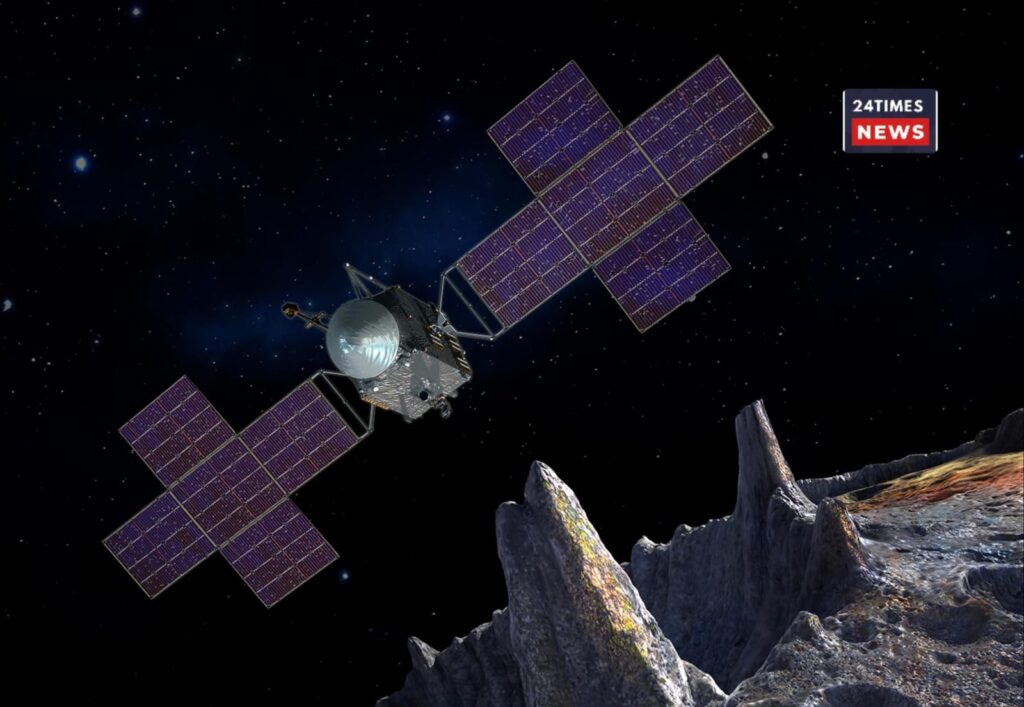
Psyche probe will pass near Mars at a speed of 20,000 km per hour, the mission will proceed with the help of gravity.
The NASA Psyche Mission Set to Create History in Space Science
Once again, a mission has emerged in the world of space science that feels like something straight out of a science fiction film. NASA’s ambitious Psyche Mission has now reached a crucial stage in its journey. On May 15th, the spacecraft will pass very close to Mars, harnessing its gravitational force to gain an additional speed of approximately 20,000 kilometers per hour.
Scientists call this process “gravity assist” or “gravity slingshot.” This technique has long been used in space missions, but each time requires extremely precise calculations and planning. This technique uses a planet’s gravitational force to change the spacecraft’s direction and speed, making it possible to travel longer distances with less fuel.
According to NASA scientists, this phase of the Psyche mission is crucial because it will allow the spacecraft to accelerate towards its final destination. This mission has been sent to study a special metallic asteroid i.e. asteroid “Psyche”, which scientists consider to be the key to understanding the early history of the solar system.
What is the Psyche mission and why is this asteroid special?
NASA has included the Psyche mission among the most important missions in space science. This mission has been sent to reach an asteroid that is considered different from typical stony asteroids. Scientists believe that the Psyche asteroid may be composed primarily of metals, with large amounts of metals like iron and nickel.
According to experts, this asteroid may be part of the core of an ancient planet. If this proves true, it could help scientists understand how Earth and other planets formed.
The mission’s objective is not only to take images, but also to study the asteroid’s composition, surface, magnetic field, and metal content. Scientists hope this could answer many long-standing questions about planetary formation.
NASA scientists say that the Psyche mission could provide a new direction for human understanding of space. This mission will try to uncover the secrets that have been hidden in space for billions of years.
Mars Will Become a “Cosmic Catapult”
On May 15th, the Psyche spacecraft will pass very close to Mars. During this time, Mars’ gravity will pull it toward itself and then impart additional momentum forward. This process is being called a “cosmic catapult,” or a cosmic slingshot effect.
According to scientists, this entire process depends on extremely precise timing and direction. A mistake of even a few seconds or a few kilometers could impact the mission’s direction. This is why the NASA team has been preparing for this for several months.
During this time, the Psyche probe will not only gain speed but also collect crucial data about Mars. Scientists will also use this opportunity to understand the Martian atmosphere and surrounding space conditions.
Experts say that gravity assist technology makes space missions more effective and less expensive. If the spacecraft were to achieve this much additional speed using its engines alone, it would require a significant amount of fuel.
The Growing Importance of New Technologies in Space Science
Space research has progressed rapidly in recent years. Space agencies in the United States, India, Europe, and other countries are constantly launching new missions. In these contexts, technologies like gravity assist have become extremely important.
Scientists say that in the future, when humans send missions to more distant planets or asteroids, the role of such technologies will increase even more. This will reduce mission costs and allow spacecraft to travel longer distances.
NASA has been working on such technologies for a long time. Planetary gravitational forces have been used in many previous missions. However, the Psyche mission is considered special because its target is a unique metallic asteroid.
According to space experts, this mission will not be limited to scientific research alone. It could also help understand the potential for space mining in the future. Although this is only an early discussion, scientists believe that metallic asteroids could become a major source of resources for human civilization in the future.
The world’s eyes are now on May 15th.
The entire world is now focused on May 15th, when the Psyche probe will accelerate its journey by passing near Mars. For scientists, this is not just a technical process but a major achievement in space science.
People on social media are also expressing great excitement about this mission, with many calling it a major triumph of human intelligence and science.
Experts say that such missions strengthen humanity’s curiosity and spirit of exploration. The pursuit of understanding the mysteries of space is what drives science forward.
If everything goes as planned, the Psyche mission could become one of the most significant achievements in space science in the coming years. This mission will not only help us understand the mysteries of space but will also demonstrate how far humanity can reach with the help of technology and science.