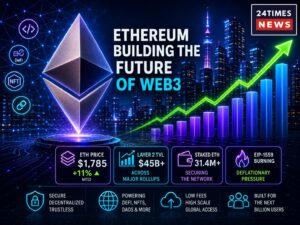
Ethereum is right at a turning point, balancing financial shifts in the wider market and real progress in its technology. The price of Ether sits around $1,800. That’s a slight recovery, after some ups and downs where global investors tightened their belts and pulled back from risk. But price is only part of the story Ethereum’s base layer is getting increasingly important as the main stage for decentralized apps, Layer-2 systems, and tokenized assets from the real world. Let’s dig a bit deeper.
Table of Contents
Market Overview: What’s Driving Ethereum
On July 12th, Ether climbed back above $1,800, settling after a wild week for crypto prices. Some global fears calmed down and investors started feeling a bit more confident, bringing attention back to stocks and tech. For Ethereum, several forces are at play:
Institutional Investors: Big groups investing through exchange-traded products (ETPs) are slowing things down for now. Higher bond yields and interest rates mean those investors are being cautious, so net inflows into ETFs aren’t as strong as they were earlier in the year.
Leverage and Derivatives: Recently, a lot of leveraged positions in Ethereum futures have been wiped out. This reset helps stabilize prices and keeps things from overheating.
Layer-2 Growth: Activity is shifting to Layer-2 networks, like Arbitrum, Optimism, Base, and zkSync. This means cheaper and faster transactions for users, though it’s causing a dip in the direct fees burned on the main Ethereum chain.
Technological Progress: Ethereum’s Modular Approach
Ethereum has changed a lot since it first appeared. Now it’s a modular system, where the base Layer-1 (L1) chain mostly handles security, consensus, and the settlement of big transactions, while Layer-2 (L2) systems pick up the slack for everyday activity.
How Modular Scaling Works
Originally, Ethereum did everything on one layer, but as more people used it, congestion and high gas fees became a big problem. Enter rollups: Layer-2 solutions that bundle transactions off the main chain and then send them back in batches. This keeps things moving, with Ethereum’s main chain staying in charge of security and settlement.
L1 Mainnet: This is still the backbone, giving top-level security, consensus, and storing everything permanently.
Optimistic Rollups: These handle smart contracts at scale, are easier for developers, and keep Ethereum compatible with existing apps.
ZK-Rollups: Using cryptographic proofs, these offer instant verification and privacy, making it possible for complex decentralized apps to work quickly and securely.
Proto-Danksharding: This upgrade introduced “blobs” cheap storage slots for Layer-2 data, cutting transaction costs even further.
Ethereum’s On-Chain Economy
Ethereum isn’t just about price; it’s about the ecosystem. The total value locked in DeFi is still bigger than anywhere else in the blockchain world.
Staking and Validator Security
Since Ethereum switched to Proof-of-Stake, more people have been running validators. Liquid staking platforms (like Lido, Rocket Pool, and EigenLayer) let people earn rewards, delegate their stake, and even “restake” to support other services like bridges and oracles. This boosts security and makes the network more efficient.
Real-World Assets: Tokenization
In 2026, Ethereum is seeing huge growth in tokenized assets. Financial institutions, governments, and asset managers are bringing money market funds, treasuries, and corporate debt onto the blockchain. Billions are now represented in these digital instruments, making global investing simpler and more direct. Stablecoins (like USDT and USDC) are also key players, processing massive amounts of cross-border payments every day.

Milestones: Ethereum’s Major Upgrades
Frontier Launch (July 2015): The start of Ethereum, letting developers build on a decentralized platform.
Beacon Chain (December 2020): Added a new consensus system (Proof-of-Stake), running alongside the old one.
EIP-1559 Fee Reform (August 2021): Created a fee-burn mechanism, helping stabilize ETH’s supply.
The Merge (September 2022): Combined all systems into a full Proof-of-Stake network and cut energy use by nearly 100%.
Shapella Upgrade (April 2023): Allowed users to withdraw staked ETH, making staking more flexible.
Dencun Upgrade (March 2024): Added data blobs, making Layer-2 even cheaper and faster.
Pectra & Modular Optimization (2025 – Mid 2026): Improved user experience, smart contract wallets, and Layer-2 data capacity.
Challenges and Outlook
Ethereum’s rise hasn’t been without issues. There’s debate over where value goes: Layer-2 networks are great for users, who get low fees, but they also reduce the amount of ETH burned on the main chain. That matters for the long-term value and security of Ethereum itself, so developers and economists keep working on new solutions.
Regulators are paying more attention, especially as traditional finance gets involved. Institutions want clear rules on staking rewards, governance, and security standards, but steady clarity in big markets keeps the momentum strong.
Looking Forward
Ethereum remains the most important platform for decentralized apps, smart contracts, and tokenized assets. By focusing on security and scaling, not shortcuts, Ethereum holds its place as crucial infrastructure for the global financial system. The ecosystem keeps expanding, and as real-world assets move on-chain, Ethereum’s influence keeps growing.