

NEET-UG Re-Exam: Delhi High Court’s Major Decision Rejects Telegram’s Appeal, Calls Temporary Ban a Necessary and Balanced Legal Step.
The NEET-UG Re-Exam, the country’s biggest exam, has once again become the center of discussion, as this issue related to the NEET-UG Re-Exam is no longer limited to the exam itself but has reached the limits of the role of digital platforms and government action.
Amid security concerns surrounding the NEET Re-Exam, the Delhi High Court’s dismissal of Telegram’s appeal has further intensified the debate. In the context of the Re-Exam, the court clearly said that the temporary ban was completely “least restrictive”, i.e. the minimum necessary and balanced step. This decision was considered necessary keeping in mind the security of the Re-Exam.
In this entire matter, -the exam became an important basis, because the future of lakhs of students is linked to this exam. The court considered the steps taken by the government to maintain the fairness of the Exam as appropriate.
This decision was taken in view of the apprehension of possible leaks and illegal activities during the Exam. This was a proactive action to safeguard the Exam, which the court did not consider unreasonable.
Telegram argued that it was not right to affect the entire platform, but the court said that this step was temporary and limited. The security of NEET-UG Re-Exam was the biggest reason behind this entire decision. Both the government and the court prioritized the credibility of the Re-Exam.This case is no longer just a legal dispute but has become an example of the digital security framework related to the NEET-UG.
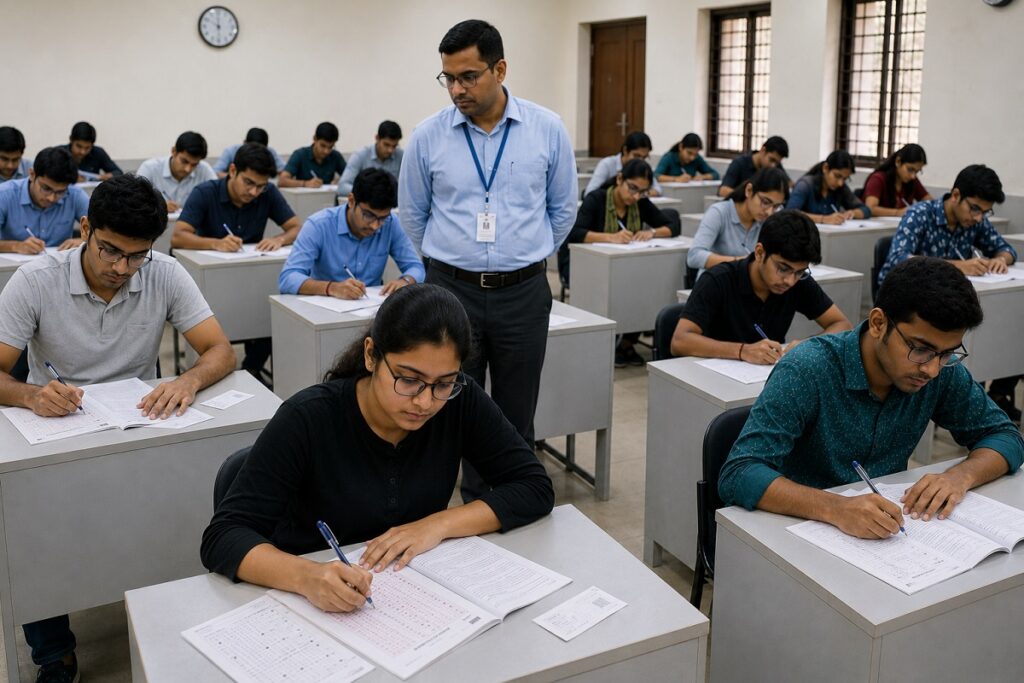
5 Key Takeaways from the NEET-UG Re-Exam Decision
- The High Court’s Clear Decision
The Delhi High Court dismissed Telegram’s appeal, stating that there was no solid basis for lifting the temporary ban on the NEET-UG.
The court held that the security and fairness of the Re-Exam was paramount, and hence the government’s action was justified.
- Use of the “Least Restrictive” Principle
The court stated that the government adopted the least restrictive measure, considering the examination.
This decision shows that limited and temporary action was taken instead of a complete ban to safeguard the NEET-UG Re-Exam.
- Security related to the NEET-UG re-exam was cited as the main reason.
The government told the court that there was a risk of information related to the re-exam being leaked and misused.
For this reason, this step was taken to ensure the security of NEET-UG Re-Exam.
- Telegram’s Opposition
Telegram stated that the entire platform should not be held responsible for matters related to the re-examination.
The company argued that action should be taken only on the wrong channels and not on the entire system.
- The Digital vs. Security Debate Intensifies
The NEET-UG issue has further intensified the debate between digital freedom and government control.
Experts believe that in cases like Re-Exam, clearer rules will be needed in the future.

The NEET-UG Re-Exam, Digital Platforms, and Future Legal Directions.
The NEET-UG Re-Exam is no longer just an exam, but a major example of digital security and administrative decisions. In India, national-level examinations like the NEET-UG Re-Exam are linked to the futures of millions of students, making their security a matter of utmost importance.
The use of digital platforms like Telegram has increased rapidly, but along with this, the possibility of its misuse also arises in cases like NEET. The government said that there was a danger of sensitive information related to NEET-UG being leaked on some channels. For this reason, a temporary ban was imposed to protect the Exam. This step was not taken as a permanent ban but as a controlled security measure.
Telegram argued that it is wrong to affect the entire platform in the name of NEET-UG. He said that action should be taken only against channels involved in wrong activities.
But the court upheld the government’s move considering the sensitivity of the NEET-UG re-exam and said it was “least restrictive”.
This case of NEET-UG Re-Exam has now become an important example towards digital governance. This shows that the government may need to take some strict measures when it comes to national exam security.
Experts believe that in cases like NEET-UG Re-Exam, digital platforms are not just technical mediums, but they have become major centers of information dissemination. Therefore their responsibility also increases.
This controversy related to NEET-UG Re-Exam also shows that in future India will have to further strengthen digital laws so that a balance is maintained between security and freedom.But the court upheld the government’s move considering the sensitivity of the NEET-UG re-exam and said it was “least restrictive”.
The NEET-UG re-exam issue has now emerged as a significant case study in the realm of digital governance. This shows that the government may need to take some strict measures when it comes to national exam security.
Experts believe that in cases like NEET-UG Re-Exam, digital platforms are not just technical mediums, but they have become major centers of information dissemination. Therefore their responsibility also increases.
This controversy related to NEET-UG Re-Exam also shows that in future India will have to further strengthen digital laws so that a balance is maintained between security and freedom.
This decision of the court is a strong indication towards securing the NEET-UG Re-Exam that public interest and exam security will be given priority.
In the times to come, cooperation between the government, the court and digital companies will become more important in cases like NEET-UG Re-Exam.
This case is no longer just a legal decision but has become a major example of security, digital rights and administrative responsibility of NEET-UG Re-Exam.

The Way Forward and Possible Improvements After the NEET-UG Re-Exam Verdict.
The NEET-UG Re-Exam case is no longer limited to a court decision, but has become a precedent that will set the future course for exam security and digital governance in India. The biggest question after this decision is how to make national examinations like NEET-UG Re-Exam more secure, transparent and technically strong.
Firstly, the examination security framework needs to be further digitally strengthened so that any possibility of leaks or illegal activity in processes like NEET-UG Re-Exam can be prevented at the initial stage itself. Advanced surveillance systems and AI-based tracking technologies can be used for this.
The second crucial aspect is transparency. In cases like NEET-UG Re-Exam, when any temporary ban or administrative action is taken, clear and timely reasons should be shared to maintain trust among students and the public.
Third, the responsibility of digital platforms has also increased further now. This decision related to NEET-UG Re-Exam has made it clear that social media and messaging apps will have to monitor suspicious activities happening on their platforms more strictly.
Fourth, there is a felt need for an independent review mechanism where any dispute or decision in matters like NEET-UG Re-Exam can be objectively reviewed. This will reduce the possibility of injustice to either party.
Finally, this entire matter indicates that in future, for examinations like NEET-UG Re-Exam, not only administrative but also technical and legal support will be equally important. This decision is both a warning and an opportunity for improvement, so that both the examination system and the digital infrastructure can become stronger and more reliable in the future.