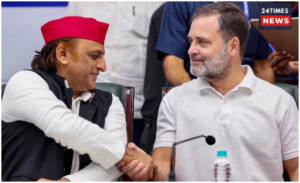
New Delhi: All political parties have begun their respective preparations for the Uttar Pradesh Assembly elections. In the national capital, Delhi, a crucial round of discussions regarding seat-sharing between the Congress and the Samajwadi Party (SP) is set to begin today, Monday. Meanwhile, efforts are also underway to outline a seat-sharing arrangement within the National Democratic Alliance (NDA).
The NDA includes the BJP, along with the RLD, Suheldev Bharatiya Samaj Party (SBSP), Nishad Party, and Apna Dal. Coordinating seat distribution within this alliance poses a significant challenge. It may soon become clear how many seats the BJP intends to allocate to its allies. Notably, the number of the BJP’s allies has increased compared to the previous Assembly elections, and all of them are demanding a larger share of seats.
How many seats might the BJP allocate to its allies?
According to sources, the BJP is considering allocating approximately 55 to 60 seats to its allies in Uttar Pradesh. This implies that the BJP itself could contest between 340 and 350 seats. However, no official announcement regarding seat-sharing has been made yet. Amidst the growing demands from its various allies, the BJP faces the challenge of keeping all partners satisfied while ensuring its own electoral equation remains strong.
How many seats is Apna Dal seeking?
Apna Dal, led by Union Minister Anupriya Patel, who serves in the NDA-led central government, may stake a claim for more seats this time compared to the past. There is talk that the party is seeking to contest between 30 and 35 seats. In the 2017 Assembly elections, Apna Dal (S) contested 11 seats and won 9.
In 2022, the party fielded candidates for 18 seats and secured 12 victories. To bolster its political strength, the party has been actively engaged in organisational activities; Anupriya Patel has already held worker conventions in Lucknow, Sonbhadra, Mau, and Ghatampur. A national convention of the party is also proposed. In this context, the BJP faces the challenge of striking a balance between the demands of Apna Dal (S) and the prospects of winning seats.
Demands of the Nishad Party
The Nishad Party also appears to be seeking more seats than it did in the previous election. In 2022, it contested 16 seats, fielding candidates on its own party symbol for 10 of these, and on the BJP’s symbol for the remaining 6. Sanjay Nishad has been consistently advocating for the inclusion of the Nishad community in the Scheduled Caste (SC) category for reservation purposes. A ‘Delhi Chalo’ (March to Delhi) convention was also held on October 21 at the Talkatora Stadium in Delhi to highlight this issue.
RLD Focused on Expansion
Jayant Chaudhary’s Rashtriya Lok Dal (RLD) may also stake a claim for a larger number of seats this time. In the 2022 Assembly elections, the RLD contested 33 seats as part of an alliance with the Samajwadi Party, winning 8 of them. This time, beyond Western Uttar Pradesh, the party is also eyeing regions such as Agra, Aligarh, Mathura, and Hathras.
Suheldev Bharatiya Samaj Party (SBSP) Also Eyes Multiple Seats
Om Prakash Rajbhar’s Suheldev Bharatiya Samaj Party (SBSP) is also expecting a higher number of seats from the BJP. In 2022, the SBSP contested the elections in alliance with the Samajwadi Party, fielding candidates in 18 constituencies. Now a part of the NDA, the party may stake a claim for more seats, leveraging its political influence in the Purvanchal region. It is understood that the party is aiming for a share of approximately 18 seats.